80%

of all sensory information
processed through vision

18 months

age at which most children
first recognize themselves in mirrors

Infinate

number of social groups a person
can belong to simultaneously

80%

of all sensory information
processed through vision

18 months

age at which most children
first recognize themselves in mirrors

Infinate

number of social groups a person
can belong to simultaneously

Definition

[ 1 ]

Definition

[ 1 ]

Sight is a pre-installed biological system that processes light entering through two forward-facing apertures in the face (eyes). It is the dominant sense in humans, responsible for approximately 80% of all information received from the surrounding world. It operates continuously while the eyes are open, without requiring consent from the user.

This document is not primarily concerned with the mechanics of vision — the retina, the optic nerve, the brain's processing of colour and movement. This document is concerned with what seeing does to you: specifically, the documented role of visual experience in forming, maintaining, and confirming a sense of who you are. This role was, for the entire duration of recorded human history, considered so obvious that it was rarely discussed. It now requires a dedicated entry.


[ Eye — primary visual aperture, self-identity confirmation unit ]

Seeing Yourself

[ 2 ]

The Mirror Problem

Seeing Yourself

[ 2 ]

The Mirror Problem

At around eighteen months of age, a human child placed in front of a mirror reaches a developmental milestone that researchers consider significant: they recognise the face in the glass as their own. Not a stranger. Not a threat. Themselves. This moment — called mirror self-recognition — is considered one of the earliest markers of self-awareness, the point at which a child begins to form the concept of "I am a specific, distinct person".

The relationship between seeing oneself and knowing oneself does not end in childhood. Throughout life, people regularly update their self-image through visual feedback: mirrors, photographs, reflections, the expressions on other people's faces when they look at you. Each of these is a form of external information that the brain folds into its ongoing model of who you are.

This matters because it means self-perception is not a fixed internal file you carry around. It is a live process, continuously updated by what you see — including what you see of yourself. Remove those visual feedback loops, and the self-image does not stay the same. It drifts.

This matters because it means self-perception is not a fixed internal file you carry around. It is a live process, continuously updated by what you see — including what you see of yourself. Remove those visual feedback loops, and the self-image does not stay the same. It drifts.

Mandatory Disclosure

The Curated Image Problem

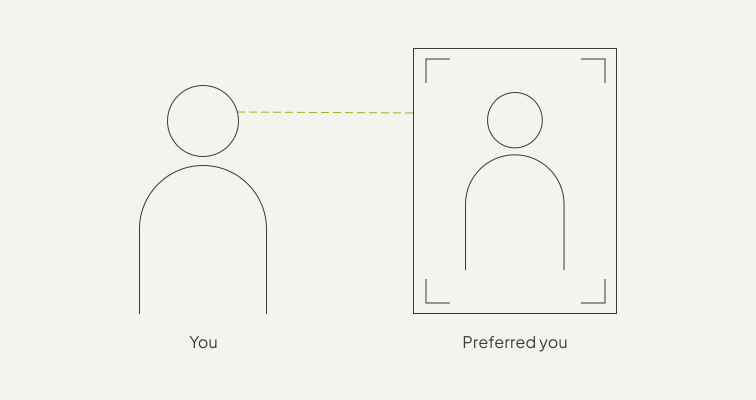
The ability to select, filter, and delete visual representations of oneself was observed to have significant and largely unexamined consequences on self-perception long before the upload era began. Studies found that people who heavily edited their own photographs reported growing distance between their actual appearance and their internal self-image. The photograph became the standard. The body became the draft.

The Archive notes, with measured neutrality, that the practice of selecting which memories to keep and which to delete — now applied not merely to photographs but to entire lived experiences — is the same mechanism, scaled up to the whole self. If editing a photograph shifts how you see your face, it seems reasonable to ask what editing your memories does to how you see your life. The Archive declines to answer this on your behalf. It hopes you will.

Mandatory Disclosure

The Curated Image Problem

The ability to select, filter, and delete visual representations of oneself was observed to have significant and largely unexamined consequences on self-perception long before the upload era began. Studies found that people who heavily edited their own photographs reported growing distance between their actual appearance and their internal self-image. The photograph became the standard. The body became the draft.

The Archive notes, with measured neutrality, that the practice of selecting which memories to keep and which to delete — now applied not merely to photographs but to entire lived experiences — is the same mechanism, scaled up to the whole self. If editing a photograph shifts how you see your face, it seems reasonable to ask what editing your memories does to how you see your life. The Archive declines to answer this on your behalf. It hopes you will.

Seeing Others

[ 4 ]

How Groups Shape Identity

Seeing Others

[ 4 ]

How Groups Shape Identity

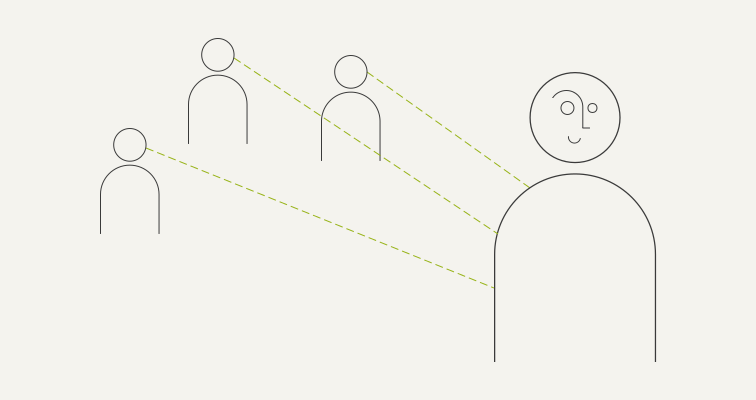
Psychologists Henri Tajfel and John Turner established in the 1970s and 1980s that a significant part of any person's identity comes not from who they are individually, but from the groups they can see themselves belonging to. Even, in controlled experiments, an entirely arbitrary group assigned at random, people would immediately begin to favor members of their new group over strangers, despite the group being meaningless and five minutes old.

The mechanism is visual before it is anything else. You look around a room and identify: who is like me. Who shares my markers. Who sees the world the way I do. From this visual sorting — which happens quickly and mostly without deliberate thought — you build a significant portion of your sense of self. Crucially, this does not produce a single fixed identity. Each person belongs to many groups at once and the identity shifts depending on which group is currently visible and relevant.

Instructions for Use

[ 5 ]

[ 1 ]

Look at a face

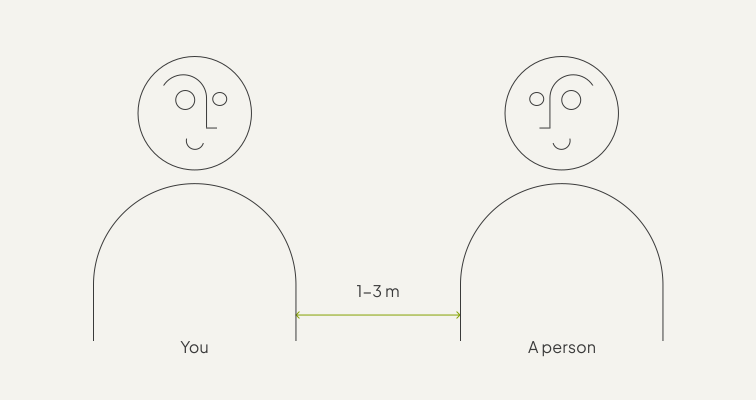
Locate another person. Position yourself within approximately one to three metres of them. Direct your eyes toward their face. This is called looking at someone.

Note:

 Do not attempt to substitute with a stored image, averaged likeness, or profile summary.

[ 2 ]

Look at yourself without assistance

Find a reflective surface — historically called a mirror — and observe your own face in it. Do not adjust the lighting. Do not apply a filter. Do not retake the observation until you achieve a preferred result. Simply look.

[ 3 ]

Be seen by a group of people

Enter a room containing multiple other people. Do not prepare a presentation. Do not distribute a profile summary in advance. Simply arrive, as you are, and allow the room to see you.

[ 4 ]

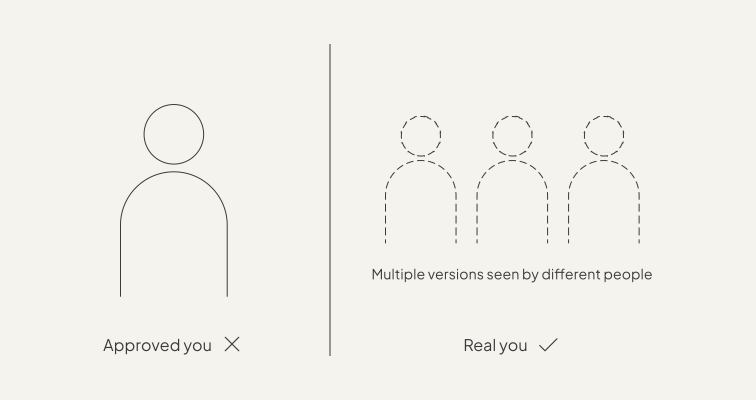
Accept that you cannot be seen correctly by a person who only knows your approved data

You will be seen incorrectly. You will be misjudged. Someone will carry an outdated version of you in their memory for years. None of this can be corrected by submitting a revised profile.

Instructions for Use

[ 5 ]

[ 1 ]

Look at a face

Locate another person. Position yourself within approximately one to three metres of them. Direct your eyes toward their face. This is called looking at someone.

Note:

 Do not attempt to substitute with a stored image, averaged likeness, or profile summary.

[ 2 ]

Look at yourself without assistance

Find a reflective surface — historically called a mirror — and observe your own face in it. Do not adjust the lighting. Do not apply a filter. Do not retake the observation until you achieve a preferred result. Simply look.

[ 3 ]

Be seen by a group of people

Enter a room containing multiple other people. Do not prepare a presentation. Do not distribute a profile summary in advance. Simply arrive, as you are, and allow the room to see you.

[ 4 ]

Accept that you cannot be seen correctly by a person who only knows your approved data

You will be seen incorrectly. You will be misjudged. Someone will carry an outdated version of you in their memory for years. None of this can be corrected by submitting a revised profile.

Field Notes

[ 6 ]

Compatibility & Known Conflicts

Compatible with

Incompatible with

Partial function

Critical conflict

Note on longevity

Storage Conditions

Sight cannot be stored in the way that data is stored. There is no discrete location for it. There is no retrieval function. You cannot export a life of seeing. You can only have lived it.

Attempts to preserve visual experience through photographs, recordings, and archived images produce something adjacent but distinct: a record of what was seen, rather than the experience of having seen it.

Shelf Life

Single image

Milliseconds to a lifetime, depending on what it contained. The face of a stranger seen once in a corridor may be gone by morning. The expression on a specific face at a specific moment — recognition, or its absence — may last until the final hour of the system's operation.

Cumulative visual identity

Irreplaceable, non-transferable, and ends with the body that accumulated it. Visual identity uploaded to an external system is a copy of the record. The sediment does not transfer. The copy knows what was seen. It does not know what it was like to see it.

Field Notes

[ 6 ]

Compatibility & Known Conflicts

Compatible with

Incompatible with

Partial function

Critical conflict

Note on longevity

Storage Conditions

Sight cannot be stored in the way that data is stored. There is no discrete location for it. There is no retrieval function. You cannot export a life of seeing. You can only have lived it.

Attempts to preserve visual experience through photographs, recordings, and archived images produce something adjacent but distinct: a record of what was seen, rather than the experience of having seen it.

Shelf Life

Single image

Milliseconds to a lifetime, depending on what it contained. The face of a stranger seen once in a corridor may be gone by morning. The expression on a specific face at a specific moment — recognition, or its absence — may last until the final hour of the system's operation.

Cumulative visual identity

Irreplaceable, non-transferable, and ends with the body that accumulated it. Visual identity uploaded to an external system is a copy of the record. The sediment does not transfer. The copy knows what was seen. It does not know what it was like to see it.

Entry sources