



~17,000 cm²
active receptor surface (standard adult unit, pre-augmentation)
0.03 s
avg. latency to oxytocin release, first contact event
Infinate
theoretical bonding capacity
~17,000 cm²
active receptor surface (standard adult unit, pre-augmentation)
0.03 s
avg. latency to oxytocin release, first contact event
Infinate
theoretical bonding capacity
Definition
[ 1 ]
Definition
[ 1 ]
Touch is a pre-installed, non-configurable, biological sensory protocol embedded across the full exterior surface of the standard human body unit. It operates without user input, cannot be toggled, paused, or filtered, and was, for several hundred thousand years, considered a feature rather than a defect.
Touch enabled information exchange between biological units via direct physical membrane contact. Unlike contemporary peer-to-peer data transfer, this protocol transmitted no structured packets, carried no verifiable metadata, and offered zero encryption. Despite these considerable technical limitations, embodied users reported it as irreplaceable. This claim has not been formally disproved.

[ Hands - typical touch instigator on standard human body unit ]
Active Compounds
[ 2 ]
Released Upon Deployment
Active Compounds
[ 2 ]
Released Upon Deployment
Oxytocin
Cortisol (reduction)
Serotonin
Endorphins
Mandatory Disclosure
Side Effects of Non-Use
Chronic non-deployment of TOUCH — a condition clinically designated as Tactile Deprivation Syndrome (TDS) — produces a documented cascade of system-level failures in biological units. These include but are not limited to:
Mandatory Disclosure
Side Effects of Non-Use
Chronic non-deployment of TOUCH — a condition clinically designated as Tactile Deprivation Syndrome (TDS) — produces a documented cascade of system-level failures in biological units. These include but are not limited to:
Delivery Formats
[ 4 ]
Delivery Formats
[ 4 ]
Touch was available in several validated delivery configurations, each associated with distinct biochemical outcomes and social encoding:
Embrace
Hand contact
Caress
Incidental
Touch was available in several validated delivery configurations, each associated with distinct biochemical outcomes and social encoding:
Embrace
Hand contact
Caress
Incidental
Instructions for Use
[ 5 ]
[ 1 ]
Ensure both biological units are present in the same physical coordinates.

[ 2 ]
Initiate contact via one of the approved delivery formats listed in Section 04.

Note:
The protocol cannot be scheduled in advance with predictable emotional outcomes. Attempt it anyway.
[ 3 ]
Maintain contact for a minimum of 20 seconds to enable full oxytocin release cycle completion.

Note:
The protocol cannot be scheduled in advance with predictable emotional outcomes. Attempt it anyway.
[ 4 ]
Do not simultaneously process notifications, broadcast feeds, or parallel communication streams during deployment. Touch coperates on undivided biological attention. It was not designed for multitasking environments and performed poorly in them.

[ 5 ]
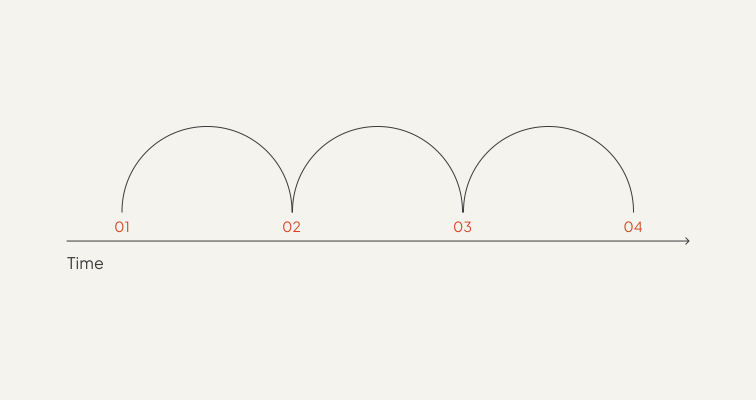
Repeat regularly. The protocol does not accumulate. There is no storage mechanism. Each instance must be re-initiated.
Note:
The protocol cannot be scheduled in advance with predictable emotional outcomes. Attempt it anyway.
[ 6 ]
Repeat regularly. The protocol does not accumulate. There is no storage mechanism. Each instance must be re-initiated.

Instructions for Use
[ 5 ]
[ 1 ]
Ensure both biological units are present in the same physical coordinates.
[ 2 ]
Initiate contact via one of the approved delivery formats listed in Section 04.
Note:
The protocol cannot be scheduled in advance with predictable emotional outcomes. Attempt it anyway.
[ 3 ]
Maintain contact for a minimum of 20 seconds to enable full oxytocin release cycle completion.
Note:
The protocol cannot be scheduled in advance with predictable emotional outcomes. Attempt it anyway.
[ 4 ]
Do not simultaneously process notifications, broadcast feeds, or parallel communication streams during deployment. Touch coperates on undivided biological attention. It was not designed for multitasking environments and performed poorly in them.
[ 5 ]
Repeat regularly. The protocol does not accumulate. There is no storage mechanism. Each instance must be re-initiated.
Note:
The protocol cannot be scheduled in advance with predictable emotional outcomes. Attempt it anyway.
[ 6 ]
Repeat regularly. The protocol does not accumulate. There is no storage mechanism. Each instance must be re-initiated.